Wednesday, March 4, 2026

How to prevent elections from being stolen − lessons from around the world for the US

Research has found that voter fraud is rare in the United States. AP Photo/Bryon Houlgrave
Shelley Inglis, Rutgers University

President Donald Trump in his State of the Union address on Feb. 24, 2026, doubled down on his false claims that the U.S. elections system is compromised. He asserted that “the cheating is rampant in our elections. It’s rampant.”

These pronouncements follow the January 2026 FBI seizure of 2020 ballots from Fulton County, Georgia, and the president’s recent call for the Republican Party to nationalize elections. The Trump administration is also suing 24 states and Washington, D.C., for voter lists to monitor voter registrations.

In his speech, Trump asked Republicans to pass the SAVE America Act. Approved by the House on Feb. 11, 2026, the measure would require that voters provide documentary proof of U.S. citizenship, effectively ending all online voter registration. “They want to cheat. They have cheated,” he said of Democrats.

These calls spread distrust in the U.S. electoral process, despite extensive evidence showing that voter fraud is rare, especially by noncitizens.

All this has led to speculation about how much further the Trump administration and Republican Party might go to tilt the 2026 midterm and 2028 presidential elections in their favor.

After decades of working internationally on democracy and peace-building, I know that efforts to undermine elections are not uncommon. Citizens of many affected countries have learned various techniques to help protect the integrity of their elections and democracy that may be helpful to Americans today.

International electoral assistance

Leaders, even in established democracies such as India, have used increasingly sophisticated and wide-ranging means to manipulate elections in their favor. Those means vary from legal changes that suppress votes to harassment and prosecution of the opposition, to promoting widespread disinformation campaigns.

These methods have evolved despite international efforts to counter rigged elections and improve election integrity. These countering efforts are called electoral assistance, and they support societies to develop electoral systems that reflect the will of the people and adhere to democratic principles.

Electoral assistance has been shown to strengthen transparency and election administration in countries such as Armenia and Mexico. It has also improved voter registration and education in countries such as Ghana and Colombia.

It’s mostly provided by international nonprofits, such as the National Democratic Institute and The Carter Center in the U.S. Multilateral organizations such as the United Nations also provide electoral assistance.
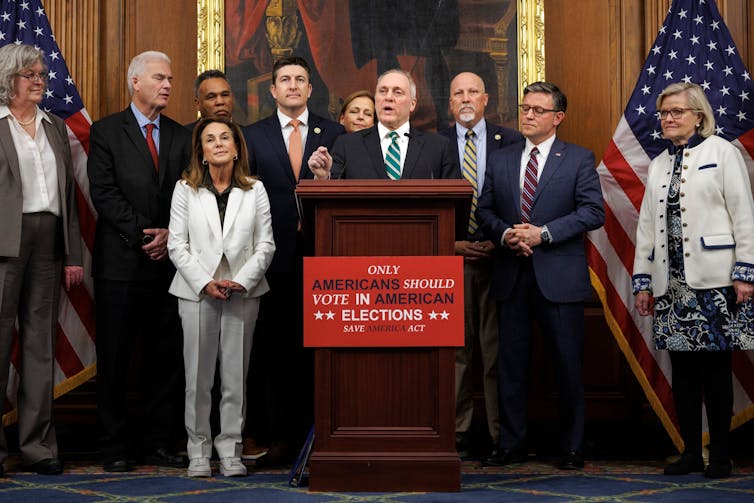
a group of men and women in formal wear stand around a podium that says ‘only americans should vote in american elections’
House Majority Leader Steve Scalise, R-La., speaks to reporters about the SAVE America Act alongside Republican leadership and supporters on Capitol Hill in Washington, D.C., on Feb. 11, 2026. AP Photo/Tom Brenner

Five international responses to electoral manipulation

Here are five areas of electoral assistance that have shown some success internationally.

Early warning and community resilience: Early warning efforts track threats of violence and intimidation against election officials, candidates and voters. They seek to mitigate risks and prepare for crises. This happens from the early stages of an election through election day in countries such as Sri Lanka and Liberia.

Law enforcement, civic groups and election officials usually undertake these efforts together. But where such direct cooperation with government authorities is not feasible, civic groups can help by undertaking risk assessments and tracking coercion and threats. They can also raise alarms with officials and the media.

Indicators, or established metrics, can track sophisticated coercion tactics such as the misuse of government funds for campaign purposes. They also can track vote buying, like civic groups in North Macedonia did during 2024 parliamentary and 2025 local elections.

For these efforts to be successful, it’s critical that networks of trusted leaders urge early action to put in place greater safeguards long before election day. Raising alarms and urging action was done successfully by religious leaders in Kenya during general elections in 2022.

Real-time disinformation and local media reaction: Real-time fact-checking and debunking of false or manipulative information has proven critical to election integrity in countries such as Mexico and South Africa.

A highly organized and fast-moving approach involving media, technology companies and authorities successfully countered disinformation to ensure a competitive democratic election in Brazil in 2022. A coalition of Brazilian media outlets, for example, fact-checked political claims and viral rumors during the election period, using innovative tools such as online apps.

Robust local media play a particularly important role. In the 2024 presidential election of Maia Sandu in Moldova, a new investigative newspaper uncovered a Russia-backed network that paid people to attend anti-Sandu rallies and to vote against the president. That outlet had received training by an expert nonprofit group. It also received free legal advice and human resource management that were critical to its effectiveness.

Neutrality, transparency and systems reform: Amid efforts to sow doubt in elections, increasing transparency and ethical standards can help build awareness and deepen trust.

Various tools, such as codes of conduct that detail ethical standards, can be formulated for candidates, media and businesses. This has been done in Nigeria and the Philippines.

International groups, including the the International Foundation for Electoral Systems, published model commitments for advancing genuine and credible elections in 2024, which have been used for preelection assessments in Bangladesh.

Additionally, major technology companies such as Google and Meta in 2024 helped draft the international Voluntary Election Guidelines for Technology Companies. Meta also helped target false content and deepfakes during Australia’s 2025 election.

The neutrality of election officials is critical to tackle distrust. In New Zealand, high levels of public trust in elections align with robust neutrality rules for public officials. The key is to develop public awareness of such commitments and how they can be useful to hold election officials, media and businesses accountable.

More profoundly, the design of the electoral system can also be linked to levels of public trust and polarization. New Zealand, South Africa and Northern Ireland, for example, reformed from winner-take-all elections to proportional representation elections to address deep internal divisions and dissatisfaction with unrepresentative results.

Broad-based mobilization and civic campaigns: Significant voter turnout that delivers large winning margins make efforts to manipulate results more difficult.

In Zambia, for example, a landslide victory for the opposition candidate in the 2021 presidential elections was driven by high youth turnout and people switching parties in urban areas.

Mobilization efforts can span from public campaigns to digital tools and voter registration and education. These efforts can motivate key groups, such as youth, minority or overseas voters. Participation of diaspora groups in Poland’s 2023 parliamentary elections was a key factor in the opposition’s win.

Proactively building public awareness of election security measures, called prebunking campaigns, has demonstrated results in increasing trust in elections in Brazil and the U.S. Additionally, civic education has shown to have positive impact on voter choice of pro-democracy candidates over their preferred party.

Strategic coalitions and nonpartisan monitoring: Nonpartisan monitoring and observation of an electoral process is a key tool in the electoral assistance tool kit. Effective monitoring often involves coalitions of nonpartisan civic groups, which Senegal has used, and faith-based organizations, as in the Philippines, to ensure adequate coverage of polling stations and consistent application of standards.

Key tools, such as parallel vote tabulation, or “quick counts,” which provide independent and statistically accurate reports on the quality of voting and counting process, have helped verify official election results in Ukraine, Ghana and Paraguay.

International observation by entities such as the Organization for Security and Cooperation in Europe assesses whether elections meet global standards. Where it identifies serious flaws or fraud, such scrutiny can help justify mass protests or mobilization, such as in Serbia’s parliamentary and local elections in 2023, trigger new elections, such as in Bolivia’s general elections in 2019, or support international condemnation, such as in Georgia’s 2024 parliamentary elections. They also make recommendations on reforms, such as changes to elections laws and systems, to strengthen integrity and align with democratic principles.The Conversation

Shelley Inglis, Senior Visiting Scholar with the Center for the Study of Genocide and Human Rights, Rutgers University

This article is republished from The Conversation under a Creative Commons license. 

The Luxury Letdown: Why Features Alone Don't Deliver the Full Car-Buying Experience

In a world where everyone is juggling busy schedules and endless choices, it’s only natural to want more from your vehicle. Not just more features, but more comfort, more quality and more enjoyment every time you get behind the wheel.

According to recent survey data from Mazda, 74% of car buyers said special features are “very” or “extremely important,” but 30% admitted they don’t have any features worth showing off to friends or family. This is the “luxury letdown;” the excitement of new features fades, leaving you wanting something more meaningful from your car.

People are looking for more than just bells and whistles. They want a car that feels good to drive, that is thoughtfully designed and that brings more joy and satisfaction to everyday life. It’s not about having the most options or the flashiest tech. It’s about all that and quality, comfort and a sense of connection that lasts long after the new car smell fades.

Beyond the Surface
Forget what you think you know about luxury vehicle features. The most memorable cars are typically built with an incredible attention to detail – a craftsmanship you can see and feel. Smart, thoughtful innovation makes driving better, not more complicated. From the shape of the seats to the way the materials feel under your fingertips, every detail is designed to enhance the experience. In fact, 80% of survey respondents said thoughtful design that makes the driving experience better is extremely or very important during the car-buying process. These subtle touches elevate the everyday and make a car feel truly special.

The Joy of Driving, Reimagined
Driving should be more than a means to get from point A to point B. The most rewarding vehicles are often those that make every journey feel intentional and enjoyable. Responsive handling, intuitive controls and a cabin designed for comfort can transform even the most routine commute into a moment of enjoyment. When a car is engineered to connect driver and road, it brings back the pleasure of driving many have forgotten. For some, this feeling gets lost beneath features and digital overload, but it’s possible to rediscover harmony between driver and car – making every trip feel intentional and rewarding.

Confidence Comes Standard
Safety is more than a feature – it’s a foundation. Advanced safety technologies and strong crash-test ratings provide peace of mind for drivers and their families. With an industry-leading number of Insurance Institute for Highway Safety Top Safety Pick+-awarded vehicles – including the Mazda3 Sedan and Hatchback, CX-30, CX-50, CX-50 Hybrid, CX-70, CX-70 PHEV, CX-90 and CX-90 PHEV – Mazda is committed to keeping safety at the forefront. Features like active safety systems, robust body structures and intelligent alerts help keep everyone protected, allowing drivers to focus on the road ahead.

Value That Surprises
Many shoppers believe a premium experience comes with a premium price tag. However, value is found in vehicles that deliver quality, innovation and comfort without the luxury markup. The materials, craftsmanship and driving dynamics often surprise those who expect to pay more for such an experience. It’s not just about what’s included, but how it all comes together to create a sense of satisfaction and pride in ownership. The result is a driving experience that feels special, accessible and built to last.

A New Standard for Everyday Driving
In a world that constantly demands so much, there is a kind of more that stands out. Not just in features, but in the feeling, the craftsmanship and the sheer joy of driving. This is the more of Mazda – a more that is intentional, meaningful and designed to enrich every journey.

When you’re ready for more from your next vehicle, visit Mazdausa.com.

SOURCE:
Mazda

Make Your Job Work for You

For some people, job dissatisfaction is the result of a crummy boss or stifling work environment. For others, the problem lies much deeper; it’s a need to reevaluate your career path and find a more suitable fit.

If you’re considering a career change but not sure which direction you’re headed, consider these words of wisdom:

Do some self-reflecting. Take time to give your current work situation a thorough analysis. Determine which elements you enjoy, what rubs you the wrong way and what you’d change if you could. Think about practical solutions to the problems you identify whether it’s changing to a different role in the same field or exploring a new industry entirely. Avoid the temptation to focus on the negative. Rather, take plenty of time to consider the positive aspects of your current job, since that insight can help inform your next step. For example, if you enjoy the limited contact you have with customers, a job with more customer-facing interaction might not be a good fit.

Ask for input. Sometimes loved ones hold the key to a happier career path because they can point out details you don’t recognize. They might recall a time when you were most relaxed and happy, or they might point out talents or skills you take for granted. Often, these natural abilities are an excellent foundation for a career because you’re well-equipped to be successful.

Consider your personal interests. Keeping your personal life and professional life separate isn’t necessarily a bad idea but finding a way to merge the two can be useful. This is especially true if you’re able to combine training or skills with something you’re passionate about. For example, if you’re an avid outdoorsman, you might find great satisfaction in applying your business management background to work for a company that specializes in camping gear.

Understand what motivates you. Landing in the right job isn’t just about having the right qualifications for a position that interests you. At the end of the day, you’ll feel most content when your job offers meaningful rewards. Motivators can be financial, or they might have more to do with the ability to learn and grow. Some people are willing to sacrifice a bigger paycheck to know they’re making a meaningful contribution in a field they care about. Knowing what outcomes resonate best can help you find a more rewarding career.

Do your research. Changing your career path is a big move, and one you shouldn’t take lightly. Before diving in, spend time looking into the field you’re considering so you have a better sense of factors like growth opportunities, job availability, qualifications, compensation and more. If you find you aren’t quite qualified for the job you think you want, explore what it will take to get there whether it’s training, education or putting in your time to gain experience and work your way into the role you desire.

A career change may be just what you need to shift your life in the direction you want. Find more career advice at eLivingtoday.com.


Tuesday, March 3, 2026

Easy, Elegant Charcuterie Boards for Effortless Holiday Hosting

When holiday occasions call for you to don your hosting cap, skip complicated appetizers and hors d’oeuvres to instead serve sustainable charcuterie with sommelier-approved wine pairings. After all, simplicity can still equal premium flavor with the right meats, cheeses and libations.

It doesn’t take a hosting expert or pairing professional to create a spread that’s as memorable as it is delicious. Charcuterie boards made with just a few ingredients can start the festivities on a high note by wowing loved ones with your pairing prowess.

Amaze your guests (and even yourself) by starting with heritage breed pork in small-batch artisanal production from Niman Ranch, whose independent family farmers and ranchers raise all animals with no antibiotics or added hormones ever. Their commitment to humane practices and sustainability leads to the exceptional flavor and tenderness your crowd craves and can taste in every bite.

Match the selection of meats – like prosciutto, genoa salame or capocollo in these recipes – with complementary cheeses and accents such as crostini, olives or even thyme-infused honey for an extra special touch. Finally, find the perfect bottle of wine for each board to round out a palate-pleasing spread that suits each guest’s preferred pairing profile.

With flavor, sustainability and a personal touch, charcuterie can bring holiday occasions to life for you and your loved ones. Visit NimanRanch.com to find more seasonal inspiration and charcuterie solutions.


Prosciutto, Sottocenere and Aligote

On a cheese board or platter, arrange buttery, silky prosciutto with Sottocenere, a firm cheese speckled with black truffle, or any firm cheese striped with dill or paprika or washed in ale. To round out these savory flavors, pair with Aligote, a white burgundy from France that’s citrusy but refined with hints of green apple and honeydew.


Genoa Salame, Vintage Grand Ewe and Syrah

On a cheese board or platter, arrange genoa salame, featuring the rich flavors pulled from the spices and wine used in its making. Pair with an aged, firm sheep’s cheese such as Vintage Grand Ewe, with notes of toasted almond, maple syrup and cultured butter. The sweetness of the cheese gives way to the genoa salame to be the star. Finish the board with skewered olives and serve with an unfussy red wine low in tannins like Syrah.


Capocollo, Aged Cheddar, Thyme Honey and Txakoli

Start your cheese board or platter with savory capocollo laced with pockets of cured fat that balance out the meat. Its mild smokiness works well with an aged sharp cheddar for a salty, intriguing but complementary match. Serve with a side of thyme-infused honey for herbaceous sweetness. Pair with Txakoli, a dry Spanish wine that’s easy to drink with hints of salt and pinesap.

SOURCE:
Niman Ranch

Monday, March 2, 2026

Jane Goodall, the gentle disrupter whose research on chimpanzees redefined what it meant to be human

Jane Goodall appears on stage at 92NY in New York on Oct. 1, 2023. Charles Sykes/Invision/AP
Mireya Mayor, Florida International University

Anyone proposing to offer a master class on changing the world for the better, without becoming negative, cynical, angry or narrow-minded in the process, could model their advice on the life and work of pioneering animal behavior scholar Jane Goodall.

Goodall’s life journey stretches from marveling at the somewhat unremarkable creatures – though she would never call them that – in her English backyard as a wide-eyed little girl in the 1930s to challenging the very definition of what it means to be human through her research on chimpanzees in Tanzania. From there, she went on to become a global icon and a United Nations Messenger of Peace.

Until her death on Oct. 1, 2025 at age 91, Goodall retained a charm, open-mindedness, optimism and wide-eyed wonder that are more typical of children. I know this because I have been fortunate to spend time with her and to share insights from my own scientific career. To the public, she was a world-renowned scientist and icon. To me, she was Jane – my inspiring mentor and friend.

Despite the massive changes Goodall wrought in the world of science, upending the study of animal behavior, she was always cheerful, encouraging and inspiring. I think of her as a gentle disrupter. One of her greatest gifts was her ability to make everyone, at any age, feel that they have the power to change the world.

Jane Goodall documented that chimpanzees not only used tools but make them – an insight that altered thinking about animals and humans.

Discovering tool use in animals

In her pioneering studies in the lush rainforest of Tanzania’s Gombe Stream Game Reserve, now a national park, Goodall noted that the most successful chimp leaders were gentle, caring and familial. Males that tried to rule by asserting their dominance through violence, tyranny and threat did not last.

I also am a primatologist, and Goodall’s groundbreaking observations of chimpanzees at Gombe were part of my preliminary studies. She famously recorded chimps taking long pieces of grass and inserting them into termite nests to “fish” for the insects to eat, something no one else had previously observed.

It was the first time an animal had been seen using a tool, a discovery that altered how scientists differentiated between humanity and the rest of the animal kingdom.

Renowned anthropologist Louis Leakey chose Goodall to do this work precisely because she was not formally trained. When she turned up in Leakey’s office in Tanzania in 1957, at age 23, Leakey initially hired her as his secretary, but he soon spotted her potential and encouraged her to study chimpanzees. Leakey wanted someone with a completely open mind, something he believed most scientists lost over the course of their formal training.

Because chimps are humans’ closest living relatives, Leakey hoped that understanding the animals would provide insights into early humans. In a predominantly male field, he also thought a woman would be more patient and insightful than a male observer. He wasn’t wrong.

Six months in, when Goodall wrote up her observations of chimps using tools, Leakey wrote, “Now we must redefine tool, redefine Man, or accept chimpanzees as human.”

Goodall spoke of animals as having emotions and cultures, and in the case of chimps, communities that were almost tribal. She also named the chimps she observed, an unheard-of practice at the time, garnering ridicule from scientists who had traditionally numbered their research subjects.

One of her most remarkable observations became known as the Gombe Chimp War. It was a four-year-long conflict in which eight adult males from one community killed all six males of another community, taking over their territory, only to lose it to another, bigger community with even more males.

Confidence in her path

Goodall was persuasive, powerful and determined, and she often advised me not to succumb to people’s criticisms. Her path to groundbreaking discoveries did not involve stepping on people or elbowing competitors aside.

Rather, her journey to Africa was motivated by her wonder, her love of animals and a powerful imagination. As a little girl, she was entranced by Edgar Rice Burroughs’ 1912 story “Tarzan of the Apes,” and she loved to joke that Tarzan married the wrong Jane.

When I was a 23-year-old former NFL cheerleader, with no scientific background at that time, and looked at Goodall’s work, I imagined that I, too, could be like her. In large part because of her, I became a primatologist, co-discovered a new species of lemur in Madagascar and have had an amazing life and career, in science and on TV, as a National Geographic explorer.
When it came time to write my own story, I asked Goodall to contribute the introduction. She wrote:

“Mireya Mayor reminds me a little of myself. Like me she loved being with animals when she was a child. And like me she followed her dream until it became a reality.”

In a 2023 interview, Jane Goodall answers TV host Jimmy Kimmel’s questions about chimpanzee behavior.

Storyteller and teacher

Goodall was an incredible storyteller and saw it as the most successful way to help people understand the true nature of animals. With compelling imagery, she shared extraordinary stories about the intelligence of animals, from apes and dolphins to rats and birds, and, of course, the octopus. She inspired me to become a wildlife correspondent for National Geographic so that I could share the stories and plights of endangered animals around the world.

Goodall inspired and advised world leaders, celebrities, scientists and conservationists. She also touched the lives of millions of children.

Two women face each other, smiling and holding a book
Jane Goodall and primatologist Mireya Mayor with Mayor’s book ‘Just Wild Enough,’ a memoir aimed at young readers. Mireya Mayor, CC BY-ND

Through the Jane Goodall Institute, which works to engage people around the world in conservation, she launched Roots & Shoots, a global youth program that operates in more than 60 countries. The program teaches children about connections between people, animals and the environment, and ways to engage locally to help all three.

Along with Goodall’s warmth, friendship and wonderful stories, I treasure this comment from her: “The greatest danger to our future is our apathy. Each one of us must take responsibility for our own lives, and above all, show respect and love for living things around us, especially each other.”

It’s a radical notion from a one-of-a-kind scientist.

This article has been updated to add the date of Goodall’s death.

Mireya Mayor, Director of Exploration and Science Communication, Florida International University

This article is republished from The Conversation under a Creative Commons license. 

Sunday, March 1, 2026

2 newly launched NASA missions will help scientists understand the influence of the Sun, both from up close and afar

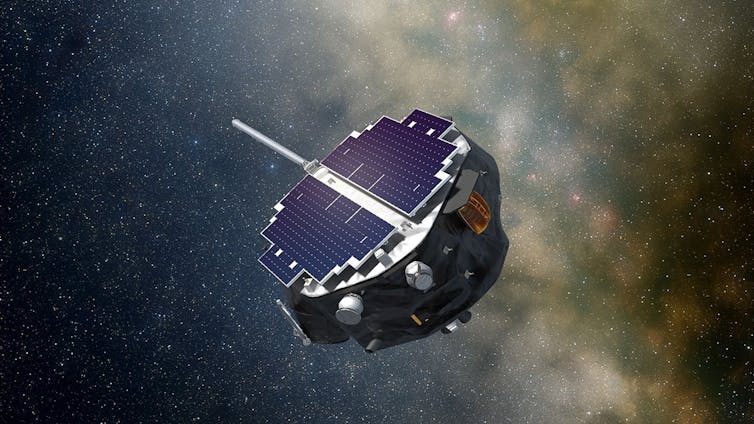
NASA’s IMAP mission is one of two launching in September 2025. NASA/Princeton University/Patrick McPike
Ryan French, University of Colorado Boulder

Even at a distance of 93 million miles (150 million kilometers) away, activity on the Sun can have adverse effects on technological systems on Earth. Solar flares – intense bursts of energy in the Sun’s atmosphere – and coronal mass ejections – eruptions of plasma from the Sun – can affect the communications, satellite navigation and power grid systems that keep society functioning.

On Sept. 24, 2025, NASA launched two new missions to study the influence of the Sun on the solar system, with further missions scheduled for 2026 and beyond.

I’m an astrophysicist who researches the Sun, which makes me a solar physicist. Solar physics is part of the wider field of heliophysics, which is the study of the Sun and its influence throughout the solar system.

The field investigates the conditions at a wide range of locations on and around the Sun, ranging from its interior, surface and atmosphere, and the constant stream of particles flowing from the Sun – called the the solar wind. It also investigates the interaction between the solar wind and the atmospheres and magnetic fields of planets.

The importance of space weather

Heliophysics intersects heavily with space weather, which is the influence of solar activity on humanity’s technological infrastructure.

In May 2024, scientists observed the strongest space weather event since 2003. Several Earth-directed coronal mass ejections erupted from the Sun, causing an extreme geomagnetic storm as they interacted with Earth’s magnetic field.

This event produced a beautiful light show of the aurora across the world, providing a view of the northern and southern lights to tens of millions of people at lower latitudes for the first time.

However, geomagnetic storms come with a darker side. The same event triggered overheating alarms in power grids around the world, and triggered a loss in satellite navigation that may have cost the U.S. agricultural industry half a billion dollars.

However, this is far from the worst space weather event on record, with stronger events in 1989 and 2003 knocking out power grids in Canada and Sweden.

But even those events were small compared with the largest space weather event in recorded history, which took place in September 1859. This event, considered the worst-case scenario for extreme space weather, was called the Carrington Event. The Carrington Event produced widespread aurora, visible even close to the equator, and caused disruption to telegraph machines.

If an event like the Carrington event occurred today, it could cause widespread power outages, losses of satellites, days of grounded flights and more. Because space weather can be so destructive to human infrastructure, scientists want to better understand these events.

NASA’s heliophysics missions

NASA has a vast suite of instruments in space that aim to better understand our heliosphere, the region of the solar system in which the Sun has significant influence. The most famous of these missions include the Parker Solar Probe, launched in 2018, the Solar Dynamics Observatory, launched in 2010, the Solar and Heliospheric Observatory, launched in 1995, and the Polarimeter to Unify the Corona and Heliosphere, launched on March 11, 2025.

The most recent additions to NASA’s collection of heliophysics missions launched on Sept. 24, 2025: Interstellar Mapping and Acceleration Probe, or IMAP, and the Carruthers Geocorona Observatory. Together, these instruments will collect data across a wide range of locations throughout the solar system.

IMAP is en route to a region in space called Lagrange Point 1. This is a location 1% closer to the Sun than Earth, where the balancing gravity of the Earth and Sun allow spacecraft to stay in a stable orbit.

IMAP contains 10 scientific instruments with varying science goals, ranging from measuring the solar wind in real time to improve forecasting of space weather that could arrive at Earth, to mapping the outer boundary between the heliosphere and interstellar space.

IMAP will study the solar wind from a region in space nearer to the Sun where spacecraft can stay in a stable orbit.

This latter goal is unique, something scientists have never attempted before. It will achieve this goal by measuring the origins of energetic neutral atoms, a type of uncharged particle. These particles are produced by plasma, a charged gas of electrons and protons, throughout the heliosphere. By tracking the origins of incoming energetic neutral atoms, IMAP will build a map of the heliosphere.

The Carruthers Geocorona Observatory is heading to the same Lagrange-1 orbit as IMAP, but with a very different science target. Instead of mapping all the way to the very edge of the heliosphere, the Carruthers Geocorona Observatory is observing a different target – Earth’s exosphere. The exosphere is the uppermost layer of Earth’s atmosphere, 375 miles (600 kilometers) above the ground. It borders outer space.

Specifically, the mission will observe ultraviolet light emitted by hydrogen within the exosphere, called the geocorona. The Carruthers Geocorona Observatory has two primary objectives. The first relates directly to space weather.

The observatory will measure how the exosphere – our atmosphere’s first line of defense from the Sun – changes during extreme space weather events. The second objective relates more to Earth sciences: The observatory will measure how water is transported from Earth’s surface up into the exosphere.

A radarlike image of a sphere, with a bright spot shown in yellow, with a green and red outline.
The first image of Earth’s outer atmosphere, the geocorona, taken from a telescope designed and built by the late American space physicist and engineer George Carruthers. The telescope took the image while on the Moon during the Apollo 16 mission in 1972. G. Carruthers (NRL) et al./Far UV Camera/NASA/Apollo 16, CC BY

Looking forward

IMAP and the Carruthers Geocorona Observatory are two heliophysics missions researching very different parts of the heliosphere. In the coming years, future NASA missions will launch to measure the object at the center of heliophysics – the Sun.

In 2026, the Sun Coronal Ejection Tracker is planned to launch. It is a small satellite the size of a shoebox – called a CubeSat – with the aim to study how coronal mass ejections change as they travel through the Sun’s atmosphere.

In 2027, NASA plans to launch the much larger Multi-slit Solar Explorer to capture high-resolution measurements of the Sun’s corona using a state-of-the-art instrumentation. This mission will work to understand the origins of solar flares, coronal mass ejections and heating within the Sun’s atmosphere.

Ryan French, Research Scientist, Laboratory for Atmospheric and Space Physics, University of Colorado Boulder

This article is republished from The Conversation under a Creative Commons license. 

Supreme Court’s Michigan pipeline case is about Native rights and fossil fuels, not just technical legal procedure

An oil pipeline runs under the Straits of Mackinac, connecting Lake Michigan and Lake Huron and separating Michigan’s Lower Peninsula from its Upper Peninsula. AP Photo/Carlos Osorio
Mike Shriberg, University of Michigan

What began as a straightforward question from one water-quality advocate has morphed into a high-stakes battle over an oil pipeline at the highest levels of the U.S. government – with implications that go far beyond the fate of a technical legal conflict.

The question arose after a 2010 Enbridge Energy oil spill in Michigan. The advocate asked what other Michigan waterways were at risk from crude oil spills. But in the wake of, among other issues, two ships doing damage to an underwater section of another Enbridge oil pipeline, the conflict has now come all the way to the U.S. Supreme Court.

On Feb. 24, 2026, the justices heared oral arguments and will thereafter deliberate about the future of Enbridge Energy’s Line 5 oil pipeline, which runs through Michigan and Wisconsin.

As a water policy scholar with a focus on the Great Lakes, I have participated directly in the Line 5 debate as a gubernatorial appointee to an advisory board, as well as analyzed its implications. I see this moment in the Supreme Court as one layer of a complex debate that Line 5 has stirred up about states’ rights, Indigenous rights and the future of the fossil fuel economy.

Enbridge Energy vs. Dana Nessel

The actual issue in front of the Supreme Court is procedural: In 2019, Michigan Attorney General Dana Nessel sued Enbridge in a Michigan state court, seeking to shut down the pipeline, alleging “violations of the public-trust doctrine, common-law public nuisance, and the Michigan Environmental Protection Act.” Federal law allowed Enbridge to seek to move the case to federal court within 30 days of the initial filing.

Enbridge did not do so, but the Canada-based multinational company has since argued that it still should be allowed to deal with the case in federal court, as it is doing in a similar case brought by Michigan Gov. Gretchen Whitmer in 2020.

The specific question before the Supreme Court is a very technical legal one: Even though Enbridge failed to request the move to federal court in a timely way, should that prevent Enbridge from moving it later?

A sensitive waterway

There is no debate that Line 5’s crossing of the Straits of Mackinac – which separate Michigan’s Upper and Lower Peninsulas right where Lakes Michigan and Huron meet – lies within Michigan’s territorial boundaries.

The lawsuits from Nessel and Whitmer are attempting to stop Enbridge from operating the pipeline in this sensitive area of the Great Lakes.

The risks became clearer to the public when a ship’s anchor struck the underwater pipeline in 2018 and another ship damaged one of the pipe’s supports in 2020. In the 2018 incident, some fluid – not crude oil – leaked into the lake water.

But Enbridge is refusing to shut the pipeline down. The company says the dispute belongs in federal court because state laws and regulations generally do not apply to this pipeline, which carries mostly Canadian oil to mostly Canadian refineries, using Michigan and the Great Lakes as a shortcut. Enbridge maintains that a treaty with Canada supersedes state authority.

The ruling from the Supreme Court will likely be narrow and procedural. However, all parties seem to agree that the decision will also have much wider consequences, including being a key determinant and signal of states’ rights to protect their waterways and other natural resources in the face of industry opposition.

Bad River Band vs. Enbridge Energy

Meanwhile, in Wisconsin, the Line 5 oil pipeline passes through the reservation of the Bad River Band of Lake Superior Chippewa, and the pending legal outcome in a separate federal court case is well beyond procedural.

The band revoked Enbridge’s easement in 2013, but Enbridge has refused to remove the pipeline, so – after years of failed negotiations – the Bad River Band sued in 2019.

U.S. District Judge William Conley ruled in 2023 that Enbridge had been trespassing for 10 years and awarded US$3 million in damage payments. Conley gave Enbridge until June 2026 to find an alternative route around the Bad River Band’s land, or shut the pipeline down.

As this date approaches with no clear resolution in sight, the Trump administration joined Enbridge in seeking to reverse that decision and keep Line 5 open. While Conley’s decision is being contested by both Enbridge and the Bad River Band in an appeals court one level below the U.S. Supreme Court, the status of the pipeline during this legal process is very much in question.

Line 5 cannot operate without the Bad River Band reservation section, but the deeper issue is about Indigenous peoples’ rights to control their own lands and future on reservations. If Enbridge wins, many analysts believe that Indigenous rights to self-determination on reservations will be significantly eroded.

Attempts to reroute

Enbridge has a two-pronged strategy to save Line 5 from decommissioning: fight in the courts against the state of Michigan and the Bad River Band, while simultaneously working to reroute the pipeline around these problematic areas.

In the Straits of Mackinac, that means attempting to put Line 5 in a tunnel underneath Lake Michigan. This requires federal permits – which will likely be issued soon – as well as state permits. The permission issued by the Michigan Public Service Commission to build the tunnel is being challenged in the Michigan Supreme Court, while advocates are pressuring Whitmer not to issue another state permit that is also required.

The situation is similar in Wisconsin, where federal permits for rerouting the pipeline outside the reservation – but not beyond the watershed serving the Bad River Band’s land – were issued in October 2025 by the Trump administration. The state permit is caught up in legal and political challenges.

In each case, the immediate issue is about the direct environmental impacts of the projects. But also in each case, the underlying battle is about the long-term effects of projects involving fossil fuels. Environmental advocates want the state and federal agencies to consider the permits in light of the potential for more climatic, health and environmental damage from burning the oil the pipeline carries. Enbridge and its allies want to focus narrowly on local ecological impacts and not on the larger debate about the future of fossil fuels.

The bigger debate

As the highest court in the land considers what some might see as a very mundane and localized issue, I believe it’s useful to peel back the layers and see deeper meaning. Jeffrey Insko, an American studies professor at Oakland University and tireless chronicler and analyst of the Line 5 saga, summarizes this depth well:

“If shutting down Line 5 were about nothing more than getting an aging pipeline out of the water, if it weren’t about addressing the climate crisis, about reducing fossil fuel consumption, about a habitable future, about cultivating better relations with the more-than-human world, about respecting Indigenous rights and lifeways, it wouldn’t be a movement worth having. It would just be a technical problem with a technical solution, one that basically accepts the way things are. But shutting down Line 5 is ultimately a step toward changing the way things are.”

The Supreme Court’s ruling may be on technical grounds, but its repercussions could be very wide indeed.

This story was updated Feb. 24, 2026, with the fact that oral arguments at the Supreme Court had concluded.The Conversation

Mike Shriberg, Professor of Practice & Engagement, School for Environment & Sustainability; Director of the University of Michigan Water Center, University of Michigan

This article is republished from The Conversation under a Creative Commons license.