Tuesday, April 18, 2023

Orbiting robots could help fix and fuel satellites in space

Machines that grip, grapple and maneuver will soon have their go at maintaining the fleet of small spacecraft that encircle Earth

For more than 20 years, the Landsat 7 satellite circled Earth every 99 minutes or so, capturing images of almost all the planet’s surface each 16 days. One of many craft that observed the changing globe, it revealed melting glaciers in Greenland, the growth of shrimp farms in Mexico and the extent of deforestation in Papua New Guinea. But after Landsat 7 ran short on fuel, its useful life effectively ended. In space, regular servicing has not been an option.

Now, though, NASA has a potential fix for such enfeebled satellites. In a few years, the agency plans to launch a robot into orbit and maneuver it to within grabbing distance of Landsat 7. The robot will use a mechanical arm to catch hold of it and refuel it, mid-air.

If successful, the mission would mark a milestone — the first time a satellite would be refueled in space. And this mission is just one of a number of planned public and private ventures intended to use robots to repair and improve the billions of dollars’ worth of satellites in orbit.

Eventually, efforts like these could lead to better and cheaper satellites that lower the cost of Internet and cell phone networks, provide better weather forecasts and give unprecedented views of planetary change and of the universe. They could even enable a new wave of in-orbit construction, with armies of robots building satellites, space stations and even Mars-bound spaceships.

Giving satellites longer lives

At the moment there are about 4,852 working satellites in orbit, playing crucial roles in communications, remote sensing and other tasks. Almost all were launched with the knowledge that if anything broke there was no way of fixing it. Most satellites also need fuel to occasionally adjust their orbits. Once that’s gone they may become so much space junk, adding to the already substantial stream of debris encircling the globe.

“Imagine you’re going to go buy a car tomorrow,” says Brian Weeden, head of an industry group called the Consortium for Execution of Rendezvous and Servicing Operations (CONFERS). “And you have to keep in mind that you’re never going to be able to put more gas in it. You can never change the oil. You can never maintain or fix anything. And you have to use it for the next 10 years. Now, how expensive and how complicated do you think that car is going to be? That’s exactly what we have been doing with satellites.”

To keep satellites working as long as possible, engineers build in redundant systems and pack in as much fuel as they can fit. All this over-engineering adds to the costs of building and launching the satellites — a modern communications satellite can cost about $500 million.

Almost all construction and repair that has happened in space so far has relied at least in part on astronauts, including fixes on the Hubble Space Telescope, and construction of the International Space Station. But sending humans into space is tremendously expensive, so the effort to develop robots to do the job has grown in recent years.

“What we would really like to do is have some way of having a robotic mechanic in space that can fix satellites when they break,” says Carl Glen Henshaw, head of the robotics and machine learning section at the US Naval Research Laboratory.

Robots to the rescue

In the last few decades, researchers have made progress toward that goal. In a 2007 NASA demonstration project, a pair of specially built craft docked in orbit and transferred fuel. More recently, in 2020, the aerospace company Northrop Grumman successfully launched two “mission extension vehicles,” equipped with their own engines and fuel, that attached themselves to two commercial satellites and boosted them into new orbits.

Two new missions expected to launch this decade will take servicing a step further. The demonstration projects will use semiautonomous robots equipped with mechanical arms to add fuel to orbiting satellites, and even to make simple repairs.

For his part, Henshaw is working on Robotic Servicing of Geosynchronous Satellites, a US Defense Advanced Research Projects Agency (DARPA)-funded mission. If it succeeds in a demonstration scheduled for 2024, it would mark the first time a robotic craft has managed to grab a satellite that was not specifically designed to dock with it. Henshaw and his colleagues recently explored some of the challenges faced in  servicing satellites with space robots in the  Annual Review of Control, Robotics, and Autonomous Systems

There are a lot of such challenges. Because existing satellites were never intended to be serviced, they lack the markings, called fiducials, that would make it easier for a robot to visually orient itself with the moving satellite. There are no fixtures designed for the robot to hold on to. And the parts of a satellite that do stick out, like antennas and solar panels, tend to be too fragile to grab.

Another problem is the time lag between the robot and Earth. For a robot operating in geosynchronous orbit, about 35,000 kilometers up, distance and signal processing create a communication delay of several seconds between the robot and its controllers on Earth. So the robot will need to handle the most crucial tasks on its own.

On the plus side, the work can build on existing robotic arms in space, including two currently in use on the International Space Station.

For a demonstration mission, Henshaw and his fellow engineers plan to choose one of the thousands of old, inactive satellites “parked” in out-of-the-way orbits. A robot would match orbits with the satellite, and maneuver to within about two meters, using cameras and a laser range finder. When it’s close enough, the robot would use one of its two arms to grab hold of an aluminum ring that previously anchored the satellite to the launch vehicle.

The other robotic arm would be able to poke and prod solar cells or antennas that have failed to unfurl correctly — a problem that happens every two or three years, Henshaw says. And it would be able to attach new instruments to the outside of satellites, such as more powerful transmitters, cameras or antennas.

Sometime after 2025, NASA plans to launch an even more ambitious robot. The On-orbit Servicing, Assembly, and Manufacturing 1 (OSAM-1) robot would first manage a complex refueling operation of an existing satellite. Then it would demonstrate that it can build completely new structures in space.

Landsat 7 will be first on OSAM-1’s to-do list. Launched in 1999 by the US Geological Survey into low-Earth orbit, about 700 kilometers high, the satellite’s work has been taken over by more advanced satellites. But it offers scientists an opportunity to test robotic refueling.

“Twenty-some years ago, technicians fueled up the satellite in preparation for launching it, and they never thought that anybody would ever touch that interface again,” says Brent Robertson, NASA’s OSAM-1 Project Manager.

OSAM-1 will use its robotic arm to cut through a layer of insulation, snip two wires and unscrew a bolt before hooking up a hose and pumping in 115 kilograms of hydrazine fuel, says Robertson. (See video here.)

Although repair and servicing of existing satellites is the most immediate goal, in-orbit assembly and manufacturing are potentially more important in the long run.

OSAM-1, for instance, has an additional mission that will carry a separate robot called the Space Infrastructure Dexterous Robot (SPIDER), designed to demonstrate that it can assemble things in space. SPIDER’s first task will be to put together a seven-piece, three-meter antenna that it carried up into orbit.

Using a process similar to 3D printing, OSAM-1 will also aim to show that it can build structural components from scratch, creating strong yet lightweight composite beams out of spools of carbon fiber and other textiles. Beams like these could be connected to form structural components of a satellite or other orbiting structures.

If the missions now in planning succeed, robotics could open a new era of space construction that is unaffordable today — fuel depots, space mining operations, roomier space stations for space tourism and even Mars-bound spaceships constructed in orbit.

“We want to demonstrate that we can build these things. No one’s done this before,” Robertson says. “If you have the capability to assemble things in space, you can bring your own material, or have material sent to you. And you can build much bigger things.”

This article originally appeared in Knowable Magazine, an independent journalistic endeavor from Annual Reviews.


Epic snow from all those atmospheric rivers in the West is starting to melt, and the flood danger is rising

Tulare Lake is reemerging as flood water spreads across miles of California farmland. Luis Sinco / Los Angeles Times via Getty Images
Chad Hecht, University of California, San Diego

To get a sense of the enormous amount of water atmospheric rivers dumped on the Western U.S. this year and the magnitude of the flood risk ahead, take a look at California’s Central Valley, where about a quarter of the nation’s food is grown.

This region was once home to the largest freshwater lake west of the Rockies. But the rivers that fed Tulare Lake were dammed and diverted long ago, leaving it nearly dry by 1920. Farmers have been growing food on the fertile lake bed for decades.

This year, however, Tulare Lake is remerging. Runoff and snowmelt from the Sierra Nevada have overwhelmed waterways and flooded farms and orchards. After similar storms in 1983, the lake covered more than 100 square miles, and scientists say this year’s precipitation is looking a lot like 1983. Communities there and across the West are preparing for flooding and mudslide disasters as record snow begins to melt.

Satellite images show farmland with only a few small lakes in early March, then a larger lake covering that farmland by early April.
Tulare Lake, long dry, begins to reemerge in March 2023 as flood water spreads across farm fields. NASA Earth Observatory

We asked Chad Hecht, a meteorologist with the Center for Western Weather and Water Extremes at the University of California San Diego’s Scripps Institution of Oceanography, how 2023’s storms compare to past extremes and what to expect in the future.

How extreme were this year’s atmospheric rivers?

California averages about 44 atmospheric rivers a year, but typically, only about six of them are strong storms that contribute most of the annual precipitation total and cause the kind of flooding we’ve seen this year.

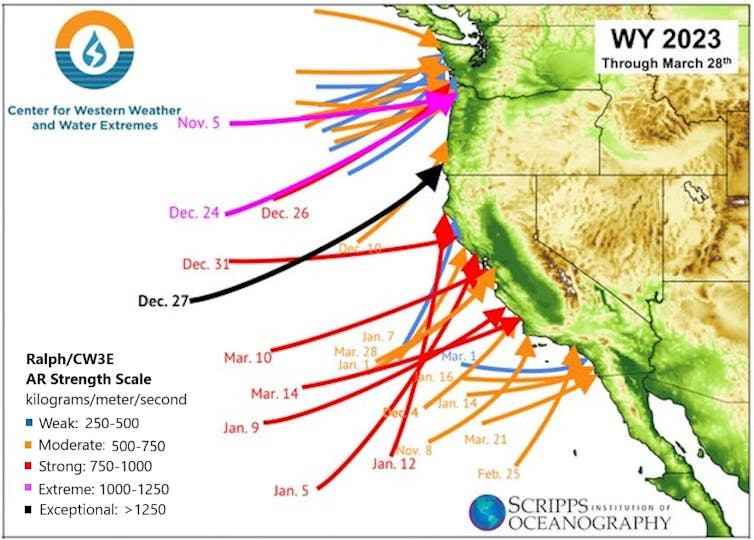
This year, in a three-week window from about Dec. 27, 2022, to Jan. 17, 2023, we saw nine atmospheric rivers make landfall, five of them categorized as strong or greater magnitude. That’s how active it’s been, and that was only the beginning.

Map of where atmospheric rivers arrived through the end of March 2023
Where atmospheric rivers hit during the first half of the 2023 water year, which started Oct. 1. The arrows show where the storms were strongest, but their impact reached far wider. Center For Western Weather and Water Extremes, Scripps Institution of Oceanography

In all, the state experienced 31 atmospheric rivers through the end of March: one extreme, six strong, 13 moderate and 11 weak. And other storms in between gave the Southern Sierra one of its wettest Marches on record.

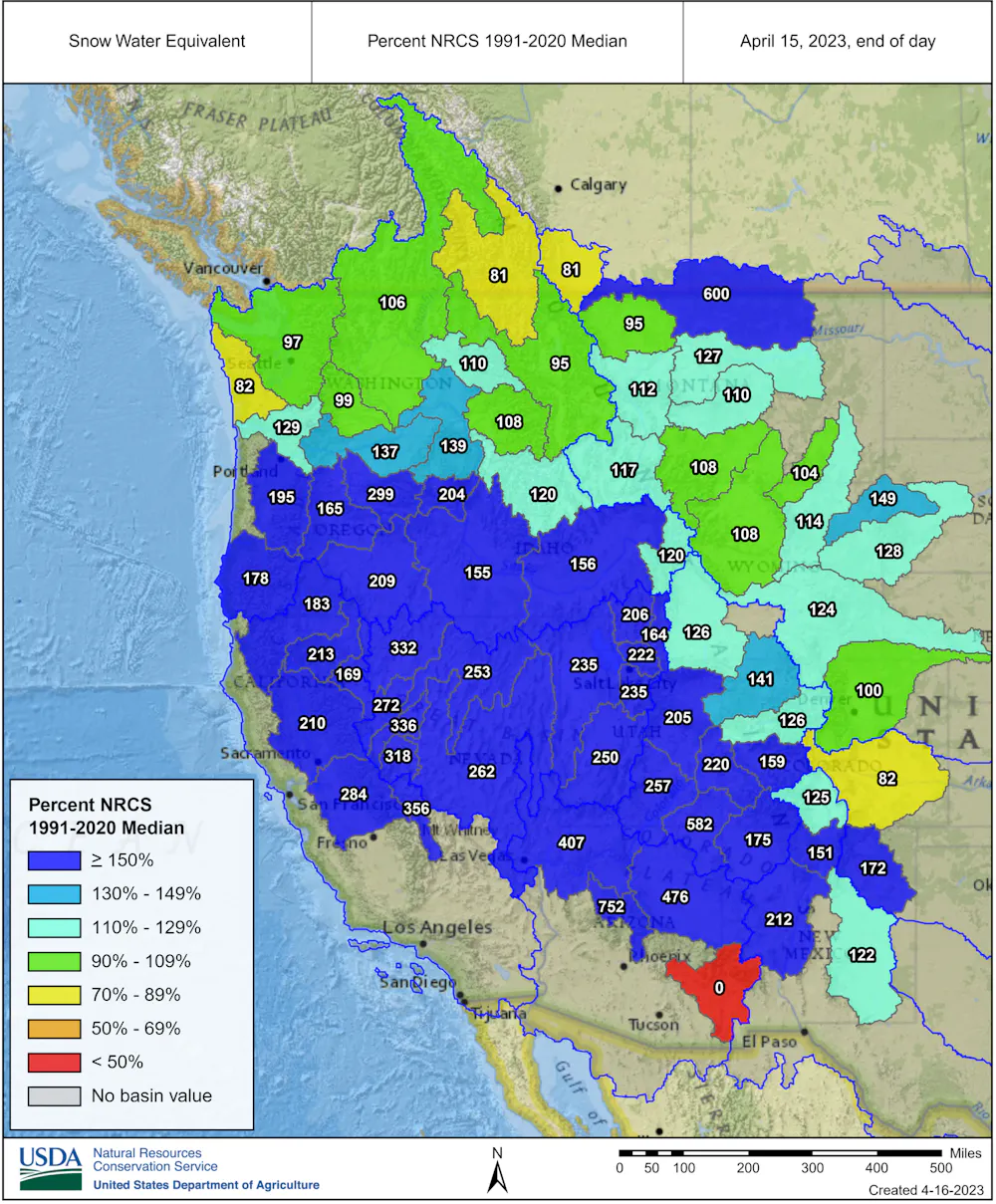
These storms don’t just affect California. Their precipitation has pushed the snow-water equivalent levels well above average across much of the West, including in Oregon, Nevada, Utah, Idaho and the mountains of western Colorado, Arizona and New Mexico.

Snow water equivalent is a measure of the water in snowpack. Many basins across the West were well over 200% of average in 2023. NRCS/USDA

In terms of records, the big numbers this year were in California’s Southern Sierra Nevada. The region has had 11 moderate atmospheric rivers – double the average of 5.5 – and an additional four strong ones.

Overall, California has about double its normal snowpack, and some locations have experienced more than double the number of strong atmospheric rivers it typically sees. The result is that Northern Sierra snow water content is 197% of normal. The central region is 238% of normal, and the Southern Sierra is 296% of normal.

What risks does all that snow in the mountains create?

There is a lot of snow in the Sierra Nevada, and it is going to come off the mountains at some point. It’s possible we are going to be looking at snowmelt into late June or July in California, and that’s far into summer for here.

Flooding is certainly a possibility. The closest year for comparison in terms of the amount of snow would be 1983, when the average statewide snow water content was 60.3 inches in May. That was a rough year, with flooding and mudslides in several parts of the West and extensive crop damage.

This year, portions of the Southern Sierra Nevada have passed 1983’s levels, and Tulare Lake is filling up again for the first time in decades. Tulare Lake is an indication of just how extreme this year has been, and the risk is rising as the snow melts.

The transition from extreme drought in 2022 to record snow was fast. Is that normal?

California and some other parts of the West are known for weather whiplash. We frequently go from too dry to too wet.

2019 was another above-average year in terms of precipitation in California, but after that we saw three straight years of drought. We went from 13 strong or greater magnitude atmospheric rivers in 2017 to just three in 2020 and 2021, combined.

Map showing well-above average precipitation across California, Nevada and Utah in particular.
The onslaught of powerful atmospheric rivers pushed precipitation to well above average across large parts of the West in 2023, following three years of severe drought. Center for Western Weather and Water Extremes, Scripps Institution of Oceanography

California relies on these storms for about half its water supply, but if the West gets too many atmospheric rivers back to back, that starts to have harmful impacts, like the heavy snowpack that collapsed roofs in the mountains this year, and flash flooding and landslides. These successive storms are typically referred to as atmospheric river families and can result in exacerbated hydrologic impacts by quickly saturating soils and not allowing rivers and streams to recede back to base flow between storms.

Are atmospheric rivers becoming more intense with a warming climate?

There’s been a lot of research on the impact of temperature because of how reliant California is on these storms for its water supply.

Atmospheric rivers are long, narrow corridors of water vapor in the sky that typically start in the tropics as water evaporates and is pulled poleward by atmospheric circulations. They carry a lot of moisture – on average, their water vapor transport is more than twice the flow of the Amazon River. When they reach land, mountains force the air to rise, which wrings out some of that moisture.

In a warming climate, the warmer air can hold more moisture. That can increase the capacity of atmospheric rivers, with more water vapor resulting in stronger storms.

An animation shows two atmospheric rivers moving across the Pacific Ocean from the tropics.
An example of an atmospheric river approaching the West Coast. Space Science and Engineering Center, University of Wisconsin-Madison

Research by some of my colleagues at Scripps Institution of Oceanography also suggests that California will see fewer storms that aren’t atmospheric rivers. But the state will likely see more intense atmospheric rivers as temperatures rise. California will be even more reliant on these atmospheric rivers for its snow, which will result in drier dries and wetter wets.

So, we’re likely to see this whiplash continue, but to a more extreme level, with longer periods of dry weather when we’re not getting these storms. But when we do get these storms, they have the potential to be more extreme and then result in more flooding.

In the more immediate future, we’re likely headed into an El Niño this year, with warm tropical Pacific waters that shift weather patterns around the world. Typically, El Niño conditions are associated with more atmospheric river activity, especially in Central and Southern California.

So, we may see another wet year like this again in 2024.

Chad Hecht, Research and Operations Meteorologist, Center for Western Weather and Water Extremes, University of California, San Diego

This article is republished from The Conversation under a Creative Commons license.

Why do mass shooters kill? It’s about more than having a grievance

A memorial for Joshua Barrick, killed by a shooter at the bank where he worked, April 10, 2023, at Holy Trinity Catholic Church in Louisville, Ky. AP Photo/Claire Galofaro
Arie Kruglanski, University of Maryland

An acutely troubling aspect of life in contemporary America is the growing proliferation of mass shootings that claim thousands of innocent lives year after painful year and make everyone feel unsafe.

The year 2023 is still young, and already there have been at least 146 mass shooting events in the U.S. on record, including the killing of five people in a Louisville, Kentucky, bank that the shooter livestreamed. There were 647 mass shootings in 2022 and 693 in 2021, resulting in 859 and 920 deaths, respectively, with no respite in sight from this ghastly epidemic. Since 2015, over 19,000 people have been shot and wounded or killed in mass shootings.

In the wake of most shootings, the news media and the public reflexively ask: What was the killer’s motive?

As a psychologist who studies violence and extremism, I understand that the question immediately pops to mind because of the bizarre nature of the attacks, the “out-of-the-blue” shock that they produce, and people’s need to comprehend and reach closure on what initially appears to be completely senseless and irrational.

But what would constitute a satisfactory answer to the public’s question?

Media reports typically describe shooters’ motives based on specific individual details of the case, on their “manifestos” or social media postings. These generally list insults, humiliations or rejections – by co-workers, potential romantic partners or schoolmates – that a perpetrator may have suffered. Or they may cite alleged threats to the shooter’s group from some imagined enemy such as Jews, people of color, Muslims, Asians or members of the LGBTQ+ community.

Though perhaps informative about a given perpetrator’s way of thinking, I believe these motives are too specific. Each shooter’s life story is unique, yet the growing number of mass shootings suggests a general trend that transcends personal details.

Posters, flowers and photos and heart shapes piled on a lawn.
Posters, flowers and portraits fill the lawn in front of Robb Elementary School in Uvalde, Texas, where a gunman killed 19 students and two teachers at the school on May 24. AP Photo/Lekan Oyekanmi

Quest for significance

Perhaps surprisingly, the general motive that drives mass shootings is a fundamental human need. It is everyone’s quest for significance and a feeling that their life matters.

That need gets activated when someone feels the loss of significance, the sense of being slighted, humiliated or excluded, but also when there is an opportunity for a gain in one’s sense of significance, being the object of admiration, a hero or a martyr in other people’s eyes.

I took part in a recent study carried out in the aftermath of the 2016 Orlando mass shooting. In that study, headed by social psychologist Pontus Leander of Wayne State University, we subjected American gun owners to feeling a loss of significance by giving them a failing score – or not – on an achievement task. We then asked this random sample of gun owners to respond to a number of questions including whether they would be ready to kill a home intruder even if they were about to leave the home they invaded, and also how empowered those gun owners felt by owning a gun.

We found that the experience of failure increased participants’ view of guns as a means of empowerment, and enhanced their readiness to shoot and kill a home intruder.

And a 2020 review of mass shooting incidents between the years 2010 and 2019 found that 78% of mass shooters in that period were motivated by fame-seeking or attention-seeking – that is, by the quest for significance.

If the need for significance is so fundamental and universal, how is it that mass shooting is an isolated phenomenon perpetrated by a handful of desperate individuals – and not by everyone?

Two factors can push this common human striving into mayhem and destruction.

First, it takes extreme heights of significance craving to pay this high a price for potential notoriety. Shooting is an extreme act that demands self-sacrifice, not only giving up on acceptance in the mainstream society, but also producing a high likelihood of dying in shootouts with law enforcement.

Research shows that about 25% to 31% of mass shooters exhibit signs of mental illness, which is likely to induce in them a deep sense of disempowerment and insignificance. But even the remaining 70%-75% with no known pathologies are likely to have suffered extreme significance issues, as attested by their ample statements about humiliation, rejection and exclusion they believe they or their group suffered at the hands of some real or imagined culprits. These feelings can create a one-track significance focus that can ultimately precipitate a mass shooting.

Yet even someone who really really wants to feel significant is not necessarily going to carry out a mass shooting.

Shortcut to stardom

In fact, most highly motivated people satisfy their egos quite differently; they focus their extremism on various socially approved areas: business, sports, the arts, the sciences or politics. Why would some then choose the repugnant road to infamy paved by the massacre of innocents?

There is a method to this madness: The shocked public attention a shooting attracts delivers instantaneous “significance.” Climbing the steep hill of a respectable career, however, is fraught with obstacles and uncertainties. Success is elusive, takes ages to attain, and is inequitably afforded to those with unusual ability, grit or privilege, or some combination of those.

Committing a mass shooting represents a widely available shortcut to “stardom.”

There are over 390 million guns in today’s America and a lack of background checks in many states. People have the freedom to purchase assault weapons at a local store. Thus, planning and executing a mass shooting is a road to notoriety open to anyone, and the narrative that links gun violence to significance – that is, the idea that by becoming a mass shooter you become famous – has been spreading ever wider with each successive shooting.

Five U.S. flags at half-staff, seen through the blossoms of a flowering tree.
Flags at half-staff in Washington, D.C., on March 30, 2023, following the mass shooting in a Nashville, Tenn., school several days before. Photo by Arturo Jimenez/Anadolu Agency via Getty Images

Killings celebrated

A final puzzle is this: If significance and respect are what the shooters are after, how come they do things that most people despise?

In today’s fractured public sphere dominated by social media, it is easy to find networks of supporters and admirers for nearly anything under the sun, including the most repugnant and unconscionable acts of cruelty and callousness. In fact, there is ample evidence that mass shooters are celebrated by appreciative audiences and can serve as role models to other would-be heroes who seek to outscore them in casualty counts.

What my colleagues and I call the “Three Ns”: need, narrative and network, refer to the would-be shooter’s need to become significant or notorious, the narrative that says being a shooter means being important, and the network that exists to support such behavior. They together combine into a toxic mixture, driving a person to carry out a mass shooting.

But this framework also suggests how the tide of this horrific epidemic may be stemmed: Negating the narrative that depicts violence as an easy path to significance and dismantling the networks that support that narrative.

The two go together. Disproving the narrative that gun violence is an easy route to fame by making it hard to obtain guns, for instance, and reducing media attention to shooters would reduce the appeal of gun violence to people seeking to feel more significant.

It is equally important to identify and make available alternative paths to significance, conveyed in alternative narratives. This would likely require a concerted effort across society and its institutions. Understanding the psychology of it all may be a necessary precondition for taking effective steps in this direction.

Arie Kruglanski, Professor of Psychology, University of Maryland

This article is republished from The Conversation under a Creative Commons license. 

Entertain in Style with a Savory Appetizer

Entertain in Style with a Savory Appetizer

Welcoming friends, family and neighbors for celebrations of all kinds demands delicious hors d’oeuvres for making guests feel right at home. Next time you invite loved ones for a special get-together, you can beef up the menu with a tasty appetizer that’s as easy to make as it is to enjoy.

Loaded with savory flavor and perfect for feeding a crowd, these Beef and Blue Cheese-Stuffed Mushrooms from Beef Loving Texans offer a simple yet mouthwatering way to entertain in style. Just prepare button mushrooms by removing the stems then fill the caps with a ground beef-based mixture of minced mushroom stems, blue cheese, breadcrumbs, green onions and steak seasoning for a party-worthy platter.

Visit BeefLovingTexans.com to find more recipes for home entertaining and beyond.

Watch video to see how to make this recipe!

Beef and Blue Cheese-Stuffed Mushrooms
Recipe courtesy of Beef Loving Texans
Total time: 50 minutes
Servings: 40

  • 2          packages (8 ounces each) button mushrooms
  • 1/4       teaspoon salt
  • 1/2       pound ground beef
  • 1/3       cup blue cheese
  • 1/4       cup whole-wheat breadcrumbs
  • 3          tablespoons green onions
  • 1/2       teaspoon steak seasoning blend
  • chives (optional)
  1. Preheat oven to 375 F. Remove stems from mushrooms; reserve. Season mushroom caps with salt; set aside. Mince stems to yield 1/2 cup; discard remaining stems.
  2. Combine ground beef, minced stems, blue cheese, breadcrumbs, green onions and steak seasoning. Spoon beef mixture evenly into mushrooms.
  3. Place stuffed mushrooms on rack in broiler pan. Bake 15-20 minutes. Sprinkle with chives, if desired.
SOURCE:
Beef Loving Texans

Explore What's Influencing Travel Trends in 2023

Immediately following the COVID-19 lockdown in the United States, outdoor and drivable destinations were in big demand for domestic travelers. As the country has reopened, Americans embraced the idea of getting back to normal and began traveling much as they did prior to the pandemic.

However, travel trends on the horizon for 2023 suggest there is no normal when it comes to travel planning. Instead, individual interests are driving decisions about where to go and what to do.

“We see a detailed and robust picture of travel into 2023,” Expedia Brands President Jon Gieselman said. “We’re seeing a surge in trips to culture capitals, a new wave of interest in wellness retreats and a spike in demand for outdoor destinations beyond just beaches and mountains. It’s not a new normal so much as people branching out to unexpected trends in what we’re calling the ‘no normal.’”

A close look at these trends suggests there is no “one-size-fits-all” approach to travel in 2023. Insights sourced from the company’s first-party data, and from custom research of thousands of travelers and industry professionals across 17 countries, show personal interests and pop culture are heavily influencing travel choices.

Consider these conclusions from the experts at Expedia:

Set-Jetters
Booking a trip after bingeing a popular series will become serious business in 2023. Research confirms streamed movies and TV shows are now the top sources of travel inspiration (40%), outpacing the influence of social media (31%). Furthermore, the small screen is now considered on par with recommendations from friends and family when it comes to travel inspiration.

In the U.S., more than two-thirds (68%) of travelers considered visiting a destination after seeing it in a show or movie on a streaming platform, and a whopping 61% went ahead and booked a trip. Top set-jetter destinations include New Zealand, with its landscapes featured in one of this year’s most epic series, followed by the United Kingdom, Paris, New York and the beach resorts of Hawaii.

Culture Capitals
National parks and rural retreats had big moments the past couple of years. Now, cities are seeing a comeback. Based on traveler demand, most of the destinations seeing the largest increases are culture-rich cities where art and culture festivities are back in full swing. Examples include the Edinburgh Fringe Festival in Scotland, WorldPride in Sydney and the cherry blossoms in Tokyo. Culture capitals that are calling loudest include:

  • Edinburgh, Scotland
  • Lisbon, Portugal
  • Tokyo
  • Dublin
  • New York
  • Sydney
  • Dubai, United Arab Emirates
  • Montreal
  • Munich
  • Bangkok
SOURCE:
Expedia

We need to stop bugs at the border

OPINION: Trade and travel come with a shared responsibility for biosecurity

In September 2022, I had just arrived in New York from West Virginia, on my way back to Australia. I opened my suitcase and out crawled three brown marmorated stink bugs, insects that are serious invasive pests. These bugs damage crops and trees in summer and are nuisance pests in houses in winter. They are so bad that they are one of Australia’s 42 national priority plant pests — a list that no one wants to be on.

I didn’t mean to pack them, of course — apparently they had crept into my West Virginia bedroom and secreted themselves in my wardrobe. In my wardrobe! Where my clothes were! That were now in my suitcase! Which I just as easily could have been opening in Australia as in New York.

This was horrifying, especially for me, a senior entomologist who specifically studies invasive insects. I am still mortified by the thought of nearly bringing brown marmorated stink bugs to Australia.

I would have been far from alone. Insects have inadvertently moved with humans for as long as humans have been moving: Think of the pubic lice, grain weevils, bed bugs, cockroaches, mosquitos and rat fleas that accompanied early voyagers. As global transportation expanded, so did the translocation of these unwanted passengers. As we traded plants between countries and continents, we broke geographic barriers that had existed for millions of years, and provided rich new habitats and food sources for insects, away from their usual competitors and enemies back home.

Today, there are over 7,000 accidentally introduced insect species living outside their native range. While only a small proportion cause damage, they are estimated to cost at least $70 billion per year. One of these, the Asia-native emerald ash borer, is among the top 10 worst invasive species, which include vertebrates and weeds (another list no one wants to be on). In the two decades since its arrival in the US — probably in imported wood packaging — it has killed tens of millions of ash trees.

The rate of invasive species entering nations shows no signs of slowing; it might be speeding up.

Just because insect invasions are rising doesn’t necessarily mean nations are bad at biosecurity: Failures are far more evident than successes, which are harder to quantify and largely go unseen. Globally, there are plenty of mitigation measures designed to reduce risks. These include pre-border regulations that balance the economics of trade against the risk of introducing new species (Australia’s import requirements for off-shore fumigation in brown marmorated stink bug’s hitchhiking season, for example, delayed the delivery of my new car last year). There are border inspections, including using sniffer dogs and acoustic devices that can hear burrowing insects; treatments at the border; and post-border surveillance and eradication measures .

So, a lot is done. But it is also true that people were largely oblivious to this problem for far too long. Stringent biosecurity measures are relatively recent, and in some countries, biosecurity is still inadequate. Europe is predicted to receive the most new invasive species over the next 25 years, and there are documented gaps in its biosecurity measures. Plants often aren’t inspected as they cross land borders, for example, which can facilitate insect invasions.

In biosecurity circles we say that “invasion begets invasion”: The more regions in which a species is invasive, the more regions from which it can spread. Countries with limited biosecurity capacity become risks to those with stricter biosecurity. So this is everyone’s problem.

I have colleagues working to strengthen biosecurity in Australia’s neighboring countries for everyone’s benefit: They’re working with the Australian Centre for International Agriculture Research, and the United Nations’ Food and Agriculture Organization, to improve biosecurity in southeast Asia and Africa. Many other countries would similarly benefit from greater international cooperation.

There are a lot of good education and citizen science projects making people aware of the impacts of invasive species. One-quarter of Australia’s most recent forest pest invasions were detected by members of the public. Community engagement is a key pillar of our new national forest pest surveillance program, designed to enhance early detection of invasive species. The more of this, the better.

Of course, risk prediction is imperfect — some insects aren’t pests in their country of origin, making it hard to predict their impact elsewhere; others weren’t even known to science until they became invasive. And there are forces that are hard to control, such as smuggling or the willful introduction of exotic insects or their hosts. For example, a sap-sucking insect called giant pine scale was intentionally introduced to pine trees in the Mediterranean, because bees feed on that insect’s honeydew to make valuable pine honey. But the giant pine scale is now killing trees, especially with the extra strain of climate change.

And then there are accidents, by even the best-intentioned.

When I finally arrived back in Brisbane, I opened my suitcase with trepidation and a can of bug spray in hand, and shook out my clothing with the windows closed. I’m not going to be ground zero for a brown marmorated stink bug incursion. Not this time, anyway. Now we just need everyone to do their part.

This article originally appeared in Knowable Magazine, an independent journalistic endeavor from Annual Reviews.
Boosting EV market share to 67% of US car sales is a huge leap – but automakers can meet EPA’s tough new standards

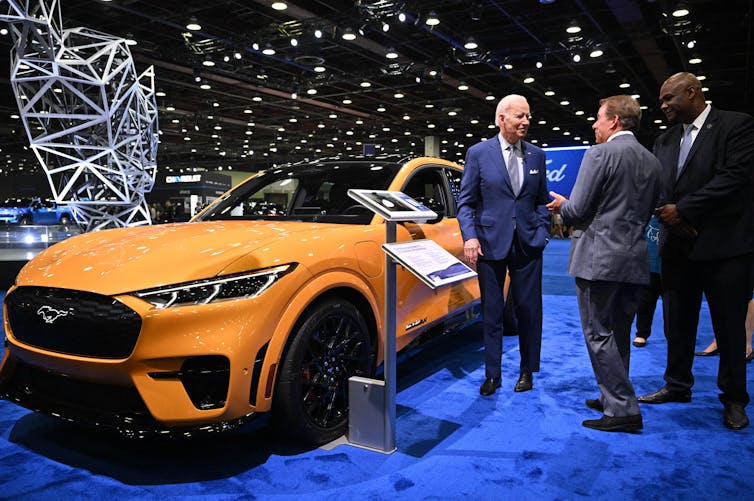
President Joe Biden speaks with Ford Motor Co. Executive Chairman William Clay Ford Jr. beside an electric Mustang. Mandel Ngan/AFP via Getty Images
Alan Jenn, University of California, Davis

One big question keeps surfacing after the Biden administration announced plans to raise auto standards so sharply they would likely boost electric vehicle production to 67% of all new passenger vehicle sales in under a decade: Can automakers pull that off?

The proposal would require a huge change in production and consumer choice. To put it in perspective, in 2022 about 6% of U.S. passenger vehicle sales were all-electric.

I study the electric vehicle industry and policy. Here’s why I think the Environmental Protection Agency’s plan can succeed.

Automakers have met tough targets before

Automakers typically push back against tougher rules and often lobby to get standards relaxed. However, U.S. car companies have also shown that they can meet ambitious goals.

When California began requiring that car companies sell a certain percentage of zero-emissions vehicles, its initial target translated to about 15% of all new car sales by 2025. Automakers quickly exceeded that goal. By 2022, nearly 19% of California’s new light-duty vehicle sales were electric. In response, the rules were ramped up last year to 100% of all new cars by 2035.

U.S. automakers are already ramping up to meet the California rules, as well as aggressive requirements in Europe and China.

The U.S. Environmental Protection Agency can’t set quotas for EV sales, but it can require automakers to progressively lower total greenhouse gas emissions from the vehicles they sell. Emission rates are inherently tied to fuel economy – more fuel-efficient vehicles emit less carbon dioxide, a greenhouse gas that is warming the planet.

The new federal proposal, which still faces a comments period and could change before being finalized, would set emissions restrictions tight enough that it will effectively result in about two-thirds of new light-duty vehicles sold by 2032 being electric. That’s almost as aggressive as rules in the European Union. A second EPA proposal, also announced April 12, 2023, affects heavy-duty vehicles in the same way, but sets a lower target.

The government is offering lots of incentives

While the proposed rules are strict, the federal government has provided unprecedented support over the last year and a half to help meet demand for EV battery parts and production, computer chips and charging infrastructure.

The Bipartisan Infrastructure Law, in conjunction with 2022’s Inflation Reduction Act, are providing billions of dollars in grants and loans for EV and battery manufacturing, plus tax breaks for EV buyers. The infrastructure law also allocated US$7.5 billion to build a network of EV chargers throughout the country under the National Electric Vehicle Infrastructure program.

In an ideal world, “carrots” like these would be enough to encourage automakers to embrace the technological shift. But the EPA’s new greenhouse gas emissions standards represent the “stick” designed to guarantee the shift happens.

EVs aren’t just luxury anymore

Making EVs affordable will be crucial to success. Tightening fuel economy and greenhouse gas emission standards is known to increase the average price of new vehicles. For now, EVs have a higher sticker price than gasoline vehicles, which is a major barrier to their adoption.

The cost of batteries is one reason EV prices are higher. But there’s another important reason, and it may be changing: the types of electric vehicles being produced.

Many of the current EV models are large or luxury vehicles. Those vehicle classes have higher profit margins, meaning automakers make more money off the sales, which helps them invest in production.

But more entry-level EVs are coming on the market soon. And many of them, such as the Chevrolet Bolt, are already fairly cost competitive with comparable gas cars – and cheaper overall when taking into account lower energy and maintenance costs.

A Nissan Leaf EV charges in a parking garage.
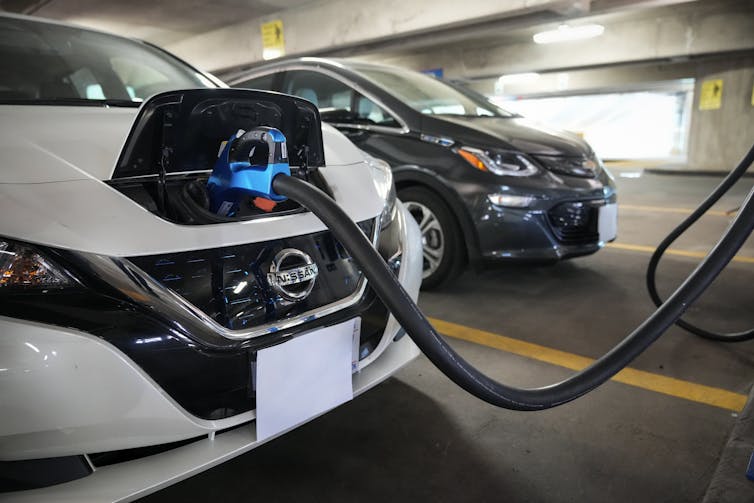
EVs are getting more affordable, but creating enough charging infrastructure is still a challenge in many areas. Drew Angerer/Getty Images

Increasing EV production will bring down costs over time as manufacturing processes improve and sales and competition grow.

In the meantime, the Inflation Reduction Act’s tax credits can help narrow the current price gap between certain EVs and gas vehicles. Buyers can get up to $7,500 for qualifying new electric vehicles.

Investments are already underway

Meeting the EPA’s standards won’t be easy, and the industry will face other challenges. For example, the U.S. needs to train workers in new skills, both for auto production and for charger installation, and it will need to boost renewable energy production to power EVs cleanly.

The ramp-up will also come with costs. Ford announced in early 2023 that its EV division had lost $3 billion in each of the previous two years and would likely lose a similar amount in 2023 as it invested in new production.

But Ford also said it expects to see an 8% profit margin by 2026 and to boost production that year to 2 million electric vehicles. Ford and several other automakers have announced large investments in electric vehicle capabilities. A recent Reuters analysis found that 37 global automakers expected to invest $1.2 trillion in EVs, batteries and materials through 2030.

John Bozzella, CEO of the industry trade group Alliance for Automotive Innovation, said automakers were committed to the EV transition and would work with U.S. regulators, but he also called the EPA plan “aggressive by any measure.” Whether it’s feasible, he said, will depend in part on how the U.S. manages charging infrastructure, supply chains and the resilience of the power grid.

The proposed rules provide clear targets

The aggressive nature of the EPA’s proposed regulation is a major departure from the norm. Efficiency standards have traditionally meant incremental improvements in vehicle technologies, like increasing engine efficiency. The proposed rule likely will be challenged once finalized, and since it isn’t written into law, there’s a chance it could be reversed by future administrations.

But these standards can help companies set goals for the future by providing clear targets. Failing to meet EPA rules can come with tough penalties, up to $45,000 per vehicle per day in some cases. That’s enough to very rapidly put any automaker out of business.

In my view, the updated standards are necessary to ensure that the U.S. can keep pace with EV adoption around the world.

Alan Jenn, Associate Professional Researcher in Transportation, University of California, Davis

This article is republished from The Conversation under a Creative Commons license.

The complex relationship between Black gamers and Hogwarts Legacy

The bestselling title is already a serious contender for the Game Awards’ Game of the Year. Mike Kemp/In Pictures via Getty Images
Steven Dashiell, American University

When the computer game Hogwarts Legacy was released in February 2023, some critics wondered whether the controversy surrounding J.K. Rowling – whose Harry Potter franchise inspired the game – would hurt sales.

Those supporting the trans community had called for a boycott of the game.

The British author has become a bête noire of many people in the trans community, repeatedly expressing and supporting views like the unfounded belief that trans women are a danger to cis women.

Nevertheless, the game, which gives players the opportunity to be young wizards making their way in the Potterverse, has proved immensely popular, selling north of 12 million copies in the two weeks after its launch. It’s already sold more units than the bestselling game of 2022, and it’s seen as a serious contender for the Game Awards’ Game of the Year.

But as a social scientist who studies gaming subcultures, I’ve been particularly interested in Hogwarts Legacy’s large following among Black gamers, who, like millions of others, seem more than willing to overlook the calls to boycott the title.

‘That wizard game’

In 2017, Rowling infamously supported social media posts seen as transphobic. Some fans wanted to know whether her beliefs were misconstrued or if she herself actually held anti-trans views.

Since then, she’s doubled down on her beliefs, penning a long post replete with stereotypes: that the trans movement is a “cover to predators,” and that it’s “seeking to erode ‘woman’ as a political and biological class.” Her refusal to reconsider these views has drawn the ire of queer communities and their allies, and Rowling’s supporters and detractors routinely spar on social media.

When Warner Bros. Games announced in September 2020 that it would be producing Hogwarts Legacy, those angry about Rowling encouraged gamers to refrain from purchasing the title.

While Rowling didn’t make the game or offer any developmental input, some LGBTQ activists believed that the game’s success would signal a tacit acceptance of her views on gender. Some of them even refuse to reference the game by its name, instead calling “that wizard game.”

‘Black folks done took over Hogwarts’

While the enthusiastic response to the game may have dismayed some activists, I saw it as a testament to the powerful draw of the franchise, which has attracted millions of fans through books, movies, apparel and theme parks over the past 25 years.

In the game, players assume the role of a new student at Hogwarts School, where they learn magic before putting on the famous “sorting hat” and embarking upon a shadowy quest to earn the respect of their instructors.

The love of this world – and the nostalgia it evokes – seems to supersede the problematic views of the creator.

And yet the game’s popularity among Black gamers might come as a surprise.

The Harry Potter books always had a broad legion of fans. Many American students – including Black students – were introduced to the Potterverse in their school years and retained a love for the characters and their adventures.

While J.K. Rowling included a handful of characters who were people of color in her books, their scant representation could be read as tokenism, at best. And long before the trans controversy, some Harry Potter fans criticized Rowling for what I call “hindsight representation”: long after the books were published, Rowling claimed that certain characters were of different ethnicities or sexual orientations, without directly highlighting their diversity in the texts.

Nonetheless, gaming boards dedicated to Black gamers were abuzz after the release. The game has gained such a foothold in the Black gaming community that one Facebook commenter triumphantly announced that “Black folks done took over Hogwarts and turned it into an HBCU” – a reference to historically Black colleges and universities.

Gaining a foothold in a white male world

Gaming subcultures have long been what sociologist Eric Dunning calls “male preserves” – spaces dominated by men. These spaces are not necessarily exclusionary; women and minorities can freely take part.

But if you aren’t a white man, it’s important to adhere to the norms and expectations in order to be accepted into the community.

Communication scholar Mia Consalvo has written about how gamers work to acquire what she calls “gamer capital” – expertise, slang and accomplishments that reflect status in gaming subcultures. The requisite benchmarks, the language used and the knowledge that’s valued have traditionally been dictated and determined by white men.

So in order to gain clout within gaming networks, gamers tend to downplay their race, gender or sexuality. And because of a default thinking that the gamer on the other side of the screen is a white male – and a prevalence of games that historically ignore issues of race, gender and sexuality – diversity in the gaming world can be easily erased.

For these reasons, it’s been easy to ignore or dismiss the presence of minority gamers, and Black gamers often struggle to be seen.

In recent years, however, that’s started to change.

In games like Forspoken and Dungeons & Dragons, developers have prioritized different genders, races and ethnicities to acknowledge the diversity of players. In the newest edition of Dungeons & Dragons, for example, the image of “human” for the race descriptions is a Black woman. In Forspoken, gamers play as Frey, a young Black girl from New York.

And this is related to what I see happening in Hogwarts Legacy. Many Black players are applauding the game’s character creator, which offers a great deal of flexibility in making avatars. In particular, those who want to play as Black characters have a vast range of skin colors, hairstyles and hair textures to choose from – choices most digital games lack.

A screen grab of a Black avatar from 'Hogwarts Legacy.'
Hogwarts Legacy offers a range of possibilities for creating Black characters. Steven Dashiell, CC BY

As scholars like Kimberly Moffitt have pointed out, hair is a central element of African American identity. Complex and thoughtful options for hairstyles in video games represent a significant shift in the recognition of Black gamers – one that challenges the kind of erasure in gaming subcultures that my research has identified.

Separating the work from the creator

How does this square with Rowling’s transphobia, and the calls to boycott the video game?

And, does this speak to the age-old belief from political science that Black Americans are socially conservative and therefore more likely to overlook homophobia or transphobia?

I would say no.

Black popular culture has a complicated relationship with the separation of artists from their work. Disgraced luminaries like R. Kelly, Kanye West and Michael Jackson generate sometimes paradoxical associations for Black people: They’re iconic Black artists who, in their personal lives, have committed crimes or expressed hateful ideas.

So many Black gamers are primed to separate Hogwarts Legacy from Rowling, particularly since the game makes huge strides in representation.

Furthermore, research overwhelmingly shows that a large majority of younger Black Americans are not socially conservative.

So in my view, their desire to be represented in games that have long excluded them serves a broader goal that likely outweighs any negative feelings toward Rowling.

Steven Dashiell, Postdoctoral Research Fellow in Sociology, American University

This article is republished from The Conversation under a Creative Commons license.

Monday, April 17, 2023

Could high-flying kites power your home?


Nearly a dozen companies are betting on computer-controlled, airborne wind energy to electrify the future

Any kid who’s ever flown a kite has learned the lesson: Once you can get the kite off the ground and high into the air, you’re more likely to find a steady breeze to keep it aloft.

A fledgling wind power industry is taking that lesson to heart. Flying massive kites 200 meters or more above the ground, companies are using the wind they find there to generate electricity.

At least 10 firms in Europe and the United States are developing variations of this kind of kite power. If they succeed, kites could make it possible to build wind farms on land that isn’t windy enough for conventional wind turbine towers. Kites might also be a better choice for offshore wind power, and one day could even replace at least some anchored towers now in use.

“It’s cheaper to manufacture, cheaper to transport and also has higher efficiency,” says Florian Bauer, co-CEO and chief technology officer of Kitekraft, a Munich-based company developing a kite power system. The carbon footprint is also much smaller, he says. “If you have all those advantages, why would anyone build a conventional wind turbine?”

But to become a widespread source of electricity, airborne wind energy, as it’s also called, needs to overcome a number of technological and commercial hurdles, as Bauer and colleagues describe in an upcoming paper in the 2022  Annual Review of Control, Robotics and Autonomous Systems. And it will need to demonstrate that it is safe, won’t harm wildlife and won’t create intolerable noise and visual disturbances for neighbors.

At the moment, kite power is in its infancy. Most companies are working on relatively small pilot projects, and none have scaled up their technology to the megawatt range that would make them comparable to conventional wind turbines. But small versions are already on the market.

In 2021, Hamburg-based SkySails Power became the first company to offer a commercial product. Its production model consists of a soft, steerable kite up to 180 square meters in area. The kite is attached by an 800-meter tether to a ground station contained in a shipping container.

In operation, the kite makes large, graceful figure eights in the sky and powers a ground-based generator capable of an average output of 80 kilowatts — enough to supply electricity to about 60 average US households. That’s small compared with a typical 2.75-megawatt wind turbine but is similar in scale to many portable industrial diesel generators. The unit is designed for use in remote locations away from the power grid.

Eventually, companies want to build larger kites capable of generating megawatts of power. They envision hundreds of kites grouped together on wind farms, providing electricity to the grid.

Harnessing speedy winds

Wind close to the ground tends to be slowed down by friction with trees, buildings and hills, and the ground itself. So the higher you go, the faster the wind can travel — at 500 meters, the breeze moves between 3 to 7 kilometers per hour faster, on average, than it does at 100 meters. Over the last few decades, there have been a number of proposals for taking advantage of these speedier, elevated winds, including sending turbines up on lighter-than-air craft, or suspending them from stationary kites. But most companies, like SkySails, are pursuing an approach that makes use of steerable, computer-controlled kites that fly patterns in the air to harvest more energy.

Airborne wind energy systems use two basic ways to generate electricity. Ground-based approaches, like SkySails, use “pumping power” to run a generator on the ground. The ground-based end of the tether is wound around a winch, and as the kite flies across the wind it pulls against the tether and unwinds the winch, driving a generator that produces electricity. Then the kite is allowed to float while it is reeled back in, and the cycle starts again.

The other approach is to generate the electricity onboard the kite. Onboard generation uses a rigid kite, similar to an airplane wing, which supports small wind turbines. When the kite flies, the wind runs the turbines and electricity generated by the craft is sent down the tether to the ground station.

Kitekraft, Bauer’s company, uses the onboard method, which allows it to make dual use of the turbine blades. During launch and landing, the blades are powered by a motor and become propellers that allow the kite to fly and hover like an airborne drone. Once the kite is at the proper height, the turbines switch to generating energy from the wind.

Kites offer a potential advantage over today’s wind towers in terms of material used. Wind turbine towers require concrete foundations and steel structures just to keep the turbines at the right height. In kite-based systems, the structures are replaced by a relatively small ground station and a lightweight tether. A study by Airborne Wind Europe, a trade association, found that a 50-megawatt kite farm would use 913 metric tons of material over a 20-year lifespan, compared with 2,868 metric tons for a typical wind tower farm. Using less material could make kite-based systems both greener and cheaper to build.

Kites may also prove useful for deep-water offshore wind generation. Today, when the water is too deep to build a foundation, wind turbines instead float on massive, barge-like structures that must be able to bear the turbines’ weight and keep them stable. Because kites are less massive, they could use lighter and cheaper barges.

But these advantages come at the cost of complexity. For kites to make sense economically, they need to operate for long periods and with little or no human supervision. That presents a tough computerized control problem, says Chris Vermillion, director of the Control and Optimization for Renewables and Energy Efficiency Lab at North Carolina State University and an adviser to Windlift, a kite-power technology company.

The kites aren’t simply floating passively in the air. Instead, they use the aerodynamics of the kite to fly “crosswind” patterns, a bit like a boat tacking back and forth across the wind. Flying perpendicular to the direction of the wind, their wings generate lift and pull even harder against the tether. This extra lift translates into extra speed, which can either pull the tether with more force for ground-based generation or be turned into greater airspeed to drive onboard turbines faster. Either way, the power available increases by at least an order of magnitude compared to flying without the crosswind motion.

But such tricky maneuvers require constant adjustment and control of the kites, by either a pilot or a computer. Rigid kites are controlled by adjusting steering components such as flaps and rudders in the same way that airplanes are flown. Soft kites are controlled by adjusting the lengths of steering lines, similar to the way a parachute is guided.

The most advanced kite systems today are capable of flying under computer control for hours or days at a time, using either onboard and on-ground computers to make constant corrections in the steering. They tend to work very well while the wind remains steady, Vermillion says.

But to go mainstream, the kites will have to be able to deal dependably with sudden and unpredictable changes such as strong wind gusts. They will also need to be able to take off and land automatically, so that they can come down during bad weather and go up when the wind is right.

“More work needs to be done to bring the technology to the level where the operational lifespans of the devices are on the order of years and decades, as opposed to demonstrations that last days and weeks,” Vermillion says.

There’s also the problem of scale. Smaller kites are cheaper to make and easier to develop. But because the weight and drag of the tether increases with height, small kites don’t operate as well at 300 meters or higher, where the wind tends to be strongest. Companies want to scale up to larger, more efficient kites that can fly higher and produce megawatts of power. But that comes with expense and risk.

Scaling up — and striking out

The fate of a company called Makani is a cautionary tale. The California-based company had the backing of Google’s parent company Alphabet and was working toward generating megawatt-scale power. But in 2020, Alphabet withdrew funding, and the company closed.

Makani was a pioneer in the technology, but faced a number of problems, including difficulty controlling the kites and several crashes. In a public report, Makani CEO Fort Felker said the company intentionally pushed ahead quickly, increasing the size of its kites in large steps, often without solving previous technological problems.

Bauer says that by scaling up so quickly without solving technical challenges along the way, the company ended up with a design that was too difficult and expensive to modify. On the other hand, he’s sympathetic. Companies that take too long to scale up to a marketable size may lose the support of their investors.

A final hurdle will be to ensure that the technology has acceptable social and environmental costs. Conventional wind farms often face opposition from nearby residents who are worried about the noise, visual distraction and aesthetics of wind turbines. Advocates of kite farms expect they will have less visual and noise impact than conventional wind towers. But according to an analysis of published studies, there is no empirical evidence that that is true. Although the kites are less massive than towers, their swooping motions and the noise they make might still cause as much or more disruption than conventional towers, according to the authors.

It’s also unclear what impact the kites will have on birds, the report says. Again, advocates think they will likely be safer for birds than wind turbines, since the kites fly higher than birds typically do. However, the tethers themselves move quickly and are hard to see, and birds might have a hard time avoiding them.

It remains unclear how widely used kite-based wind power will become. Advocates like Bauer are confident that they can solve the engineering and computing problems to make the kites cost-effective.

But a 2021 US Department of Energy report to Congress sounded a cautionary note, calling kite power “an immature and unproven technology that requires significant further development before it could be deployed at meaningful scales at the national level.” The cost of electricity created by conventional wind turbines has also continued to fall, making it that much harder for kite power systems to show that they have an advantage, the report said.

“I do not see airborne wind energy systems as a replacement for most existing conventional turbines that are installed on land,” agrees Vermillion. But he does think that they will find a niche over the next decade in military and off-grid uses, potential applications the company he consults with lists as among their targets for kite power. And he thinks that at some point they could be the preferred technology for deep-water wind farms, where their light weight will give them a big advantage over tower-based turbines.

This article originally appeared in Knowable Magazine, an independent journalistic endeavor from Annual Reviews.